Sat on a panel on localization last week in a meeting of aid economists (no more detail, sorry – Chatham House Rule). It was definitely a different tone to the usual conversation on localization, which concentrates on issues of power, equity, decolonization etc.
Here, there was a striking focus on efficiency/value for money, which is of course what floats economists’ boats. Can localization de-layer the traditional aid supply chain, through which multiple intermediaries skim their percentage off the top before passing on the shrinking pot to the next player down the line?
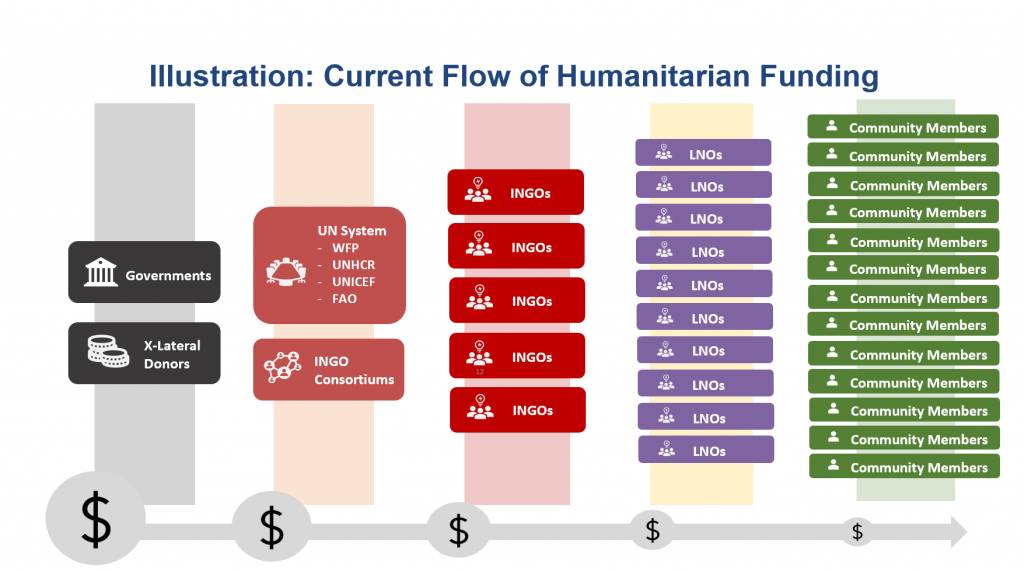
To de-layer, the donor should start with a flat structure (e.g. donor funds local NGOs directly), and then ask ‘what is the value of adding an extra layer?’ Working in this way could free up a lot of $ at a time of huge pressure on aid budgets.
As would making more use of local actors, and less of internationals. Headline finding: ‘local intermediaries could deliver programming that is 32% more cost efficient than international intermediaries.’
I’ll try and get my fellow panelists to blog their research on this.
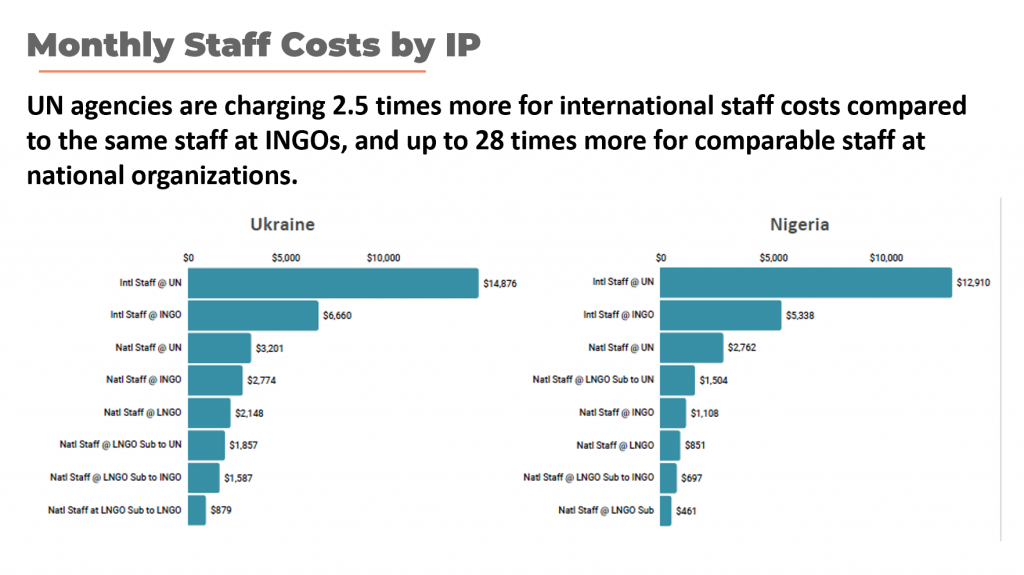
The UN comes out of this research particularly badly. They keep all the 7% overheads from donors, whereas INGOs typically pass on a portion of this to their partners, a form of core funding that enables local organizations to build their structures and capacity. Plus UN costs are much higher (see graphic).
Other parts of the conversation were more familiar to me:
- Discomfort with the word ‘localization’ (which itself sounds increasingly colonial – would a genuine local actor ever chose to call it that?). ‘Locally-led development’ is becoming more popular – the UK FCDO has an internal ‘Locally Led Working Group’, which sounds promising.
- Localizing is about a lot more than money. For example, knowledge. In Ghana, commissioning the standard political economy analysis from Ghanaian researchers rather than the usual fly-in-fly-out consultants got better results as well as strengthening local research capacity. Government officials were more likely to open up to homegrown consultants, especially when the interviews were conducted in a local language rather than English.
- Perceptions of risk are not the same as actual risk. In particular, research suggests local partners are no more likely to misuse of funds than international players. And that matters because of the cost issue: ‘Donors pay a high price for the perceived risk they are trying to avoid’.
- Churn: international staff rotate in and out after a few years, so never really understand the context they are operating in. ‘How do you manage risk if you are new to a country, which we always are?’ Suggestions included ‘pre-positioning your relationships’ – i.e. investing in a lot of networking as soon as you arrive in post, so that when a hurricane/earthquake/hunger crisis strikes, you won’t just turn to the comfort of the international aid business. Also, of course, listening to local staff, who know the country and do not rotate in and out anywhere near as fast – but that requires a big rethink of hiring and hierarchy within donor offices.
- No-one actually used the word ‘racism’, but the implication was clearly there (at least for me) – the business-as-usual preference for international organizations over national is often not based on evidence, but on prejudice.
I came away impressed at the seriousness with which this particular donor is addressing the issue, and wondering if we need a ‘friends of localization’ network/community of practice, bringing together advocates within donors, the multilateral system, INGOs and (of course) local organizations to plot and strategize about how to combine evidence, examples and advocacy to budge an issue that has been very stuck for far too long, but which feels ripe for progress.
But when I sent this draft to my fellow panelists, they threw up their hands in horror at the idea of another talking shop: partners ‘want to see action and solutions not repetitive consultation that tends not to advance beyond focusing on the barriers. I think the reason for lack of impact is that endless consultation manifests as a form of procrastination to avoid focusing resources on doing something about it.’
Views?